Under the hum of the power lines that crisscross southern Quebec lie hundreds of hectares of narrow prairie populated by grasses, shrubs and, of course, wildlife.
Within these Hydro‑Québec “corridors,” which perhaps surprisingly contain some of the province’s most diverse ecologies, you’ll find nesting songbirds, foraging bumblebees and cute caterpillars transforming into beautiful butterflies.
It’s also an overlooked conservation opportunity, and the city of Terrebonne is among a number of municipalities in southern Quebec and southern Ontario working hard to seize it so that they can protect and restore its nature before more development arrives.
Protecting pollinator habitat recognizes the critical role these species play in a broader ecosystem. “If we remove pollinators, it’s like removing the foundation of a house,” says Robin Bourgeois, a biodiversity technician working with the city, which lies just north of Montreal across the Mille Îles River.
“Every insect, every bird, every plant has its ecological role.”
Bourgeois is part of a team of researchers, restoration practitioners and City of Terrebonne staff working to restore and maintain these corridor lands. By helping the pollinators there thrive, the whole ecosystem benefits: plants are more genetically diverse and resilient to climate impacts, store more carbon, prevent flooding, and provide cooling shade and protection from wind for species large and small.
“Southern Quebec is a hotspot for biodiversity, but it’s under threat too,” says Steve Hamel, senior specialist, biodiversity and restoration at WWF‑Canada, which has been supporting this work for more than six years.
The hydro corridors run through some of the most densely populated regions in Canada, which are also home to many species at risk. The objective of the corridor restoration, says Steve, is to improve habitat to ensure that this critical biodiversity is maintained. “Hydro‑Québec’s power lines,” he adds, “are a great spot for that.”
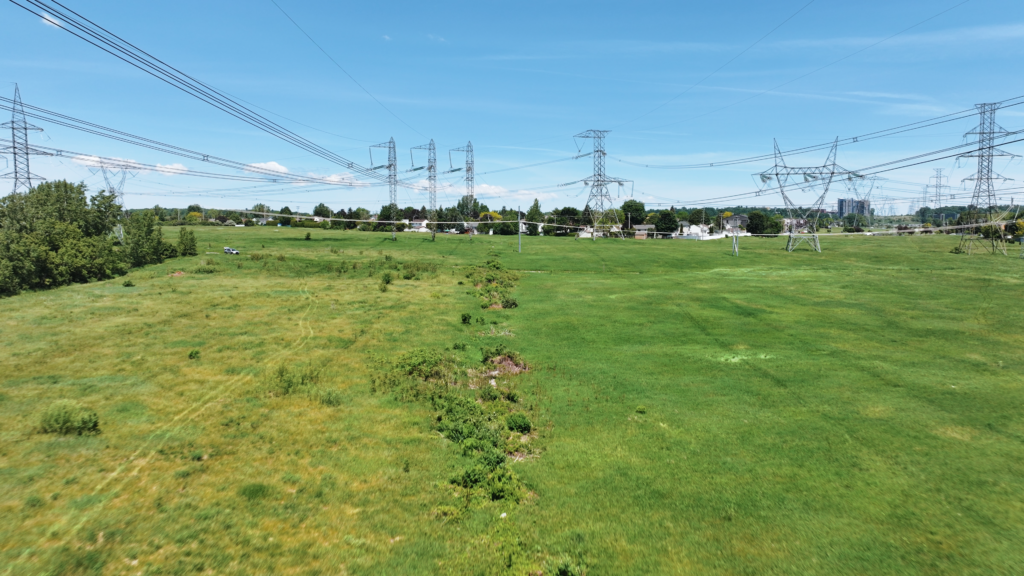
This is one of many projects supported by WWF-Canada’s Catalyst Fund, an initiative launched in 2026 to boost restoration efforts across the country. Over in Terrebonne, that support has already created a field of wildflowers and facilitated the planting of 400 edible shrubs and low flowering trees — eastern buttonbush, black chokeberry and Canada service berry among them — that are beneficial for pollinators. It’s also helped identify and protect key habitats before planned development arrives while growing a multi-faceted team of restoration practitioners, ranging from specialized researchers to community gardeners.
A cherished sight — and site — for communities
When Terrebonne released its strategic plan in 2021, which included conservation, more than 400 people participated in consultations, a clear sign that residents are deeply attached to the nature that surrounds them.
Karine Dancosse, the section chief for nature and ecological resilience at the City of Terrebonne, shares how public education reminded the community that these ecosystems serve essential functions. “We explain to citizens the ecological chain that comes with a biodiversity corridor,” she says, adding that one way they do that is by mitigating the impacts of flooding and heat waves. “We have many wetlands in the corridor. When there is heavy rain, these wetlands help retain water. They also bring a lot of cooling.”
But besides being functional, these corridors are also beautiful, and it’s something the city has observed can be its catalyst to conservation. “The more people enjoy it, the more they love it,” says Dancosse, “and the more they love it, the more they take care of it. Walking in the forest, biking — all of that came out as very important. People want privileged access to nature.”
Restoring and protecting the corridor
Before restoration can begin, one must first take stock. “The first thing we do is inventory,” says Bourgeois. “We start by seeing what’s on the site — species at risk, species to remove, what we want to conserve. Then we plan the project with partners, looking at what restoration or habitat work we’ll do.”

Next is setting up the site for replanting native species, which often means uprooting others. For some areas, the approach can be straightforward: pulling out invasive shrubs by hand and collecting pollinator samples.
Other areas are a little more complicated. Some are so overrun with garlic mustard, an invasive plant that forms dense monocultures, that manual removal is impossible. For these spots, Bourgeois and his team cover large patches of land with tarps to deprive them of sunlight.
“It’s much simpler to cover the area for a few years to exhaust the seed bank,” he explains. “That’s what we did here. The plants die without light, and the seeds degrade. After that, we can replant native species: grasses for field birds like bobolink and eastern meadowlark.”
Then the planting begins. Keelan Jacobs, a wildlife biologist with Quebec’s Ministry of the Environment, explains how planting both shrubs that flower early in spring and herbaceous flowers that bloom throughout the year give pollinators the sustained food and energy they need. Vegetation must remain low for safety and to maintain power-line access, but there’s still plenty of habitat to go around.
During the planting work, Jacobs and his team are also adding to the area’s “micro-topographies” by creating depressions in the soil in some areas and one-metre-tall sand mounds in others that together create small variations in the terrain. The result is a dynamic physical environment with variations in temperature, sunlight exposure and moisture levels across short distances. This makes it attractive to pollinators, which need a diversity of nesting sites and niches for burrowing and hiding, and it’s a welcoming environment to the plants that sustain them.
But successful restoration doesn’t just include planting — it also needs stewardship. Maintaining the area will involve both active and inactive approaches: removing invasive plants makes room for native species, while limiting mowing to once every three years allows those species to thrive undisturbed for longer stretches.
“Every gesture that benefits biodiversity and natural environments, even if small, is important,” says Jacobs. “Without that, we won’t meet the objectives of maintaining these beautiful natural environments in the south of the province and elsewhere for the future.”
Over time, Terrebonne will monitor the number of pollinators that use the restored sites to know how well their efforts are working.
But there is already much more than electricity buzzing through the hydro corridors of Terrebonne, proving that conservation can happen in unexpected places if communities make sure to make room for nature.
The post Beneath the wires, Terrebonne builds a refuge for Quebec wildlife appeared first on WWF.CA.