Home Budget

Budget

What Works (and What Doesn’t) for Canadian Advocacy Campaigns in the AI Era

0


Ever since Canadians ubiquitously adopted smartphones, the digital advocacy playbook has been well rehearsed: sharp messaging, precise targeting, smart audience analysis, and grassroots tactics that grow a movement.

AI is rewriting that playbook. What once took campaigns weeks to build now takes hours – and that’s changing what actually moves decision-makers.

How Has AI Upended Grassroots Advocacy?

A campaign’s nerve-centre has typically been a microsite with a letter-writing or petition tool. Supporters add their names, often with a personal comment or email. With some luck and virality, submissions grow exponentially. At critical mass, backed by effective government relations, politicians could often be moved.

Each of those steps used to take significant time, staff and budget. Today, AI can speed up nearly all of them. For example:

  • Social media: A large language model (LLM) can help plan, draft, and curate a campaign’s posts quickly and at low cost
  • Video: Short animated explainer videos can be produced in a few hours using a handful of prompts – plain-language instructions typed into an AI tool
  • Website: AI website builders can create a campaign microsite – the page where supporters sign on – from a written description, without hiring a web developer
  • Letter-writing tool: Someone with no coding experience can use AI to build a webform that matches each supporter to their elected officials by postal code and sends their message directly
  • Supporter messages: Supporters can type a few words into the form and have AI instantly turn them into a full-length letter

That raises an important question: if AI agents, tools that complete tasks on their own, and LLMs can do so much of the work, including writing the letters, how much is grassroots advocacy still worth?

Measuring Your Impact

In the early days, campaigners just wanted to post a big number of emails sent on the virtual scoreboard. Remember when the Obama Administration would provide an official response on a topic if enough Americans signed a petition at whitehouse.gov?

When the “We the People” platform launched in 2011, the goal was 5,000 people; it was upped to 25,000 and then 100,000 by 2013.

Once form emails started coming in en masse from the other side of the country, or suspected bots, their power diminished. Staffers have also figured out that a filter is a simple fix for inbox inundation: all messages with the same text go into a folder, either deleted or unread.

AI adoption has only accelerated this trend. Therefore, aiming for high quality over any quantity has become even more critical.

What Still Works: Impactful Messages Delivered with an Emotional Appeal

AI can help a campaign launch faster and even write emails on behalf of citizens. What it cannot replace is what has always moved elected officials: real constituents explaining why an issue matters to them. That remains the core of representative democracy.

Smart practitioners are shifting their focus from prompting the AI to prompting the humans who make grassroots advocacy possible. That means:

  • Asking supporters to offer a phone call or in-person meeting in their letters, which signals a real constituent behind the message
  • Encouraging real, personal stories that evoke an emotional response – the kind of detail a template or LLM cannot invent
  • Organizing in-person activity, such as rallies large or small, that makes community support visible
  • Sharing homemade visual content that delivers key messages with an authenticity polished production cannot match

None of these tactics are new. They are the fundamentals of campaigning and public relations: credible messengers, personal relationships, earned attention and a visible presence in the community.

As AI fills inboxes and feeds with polished but interchangeable content, these fundamentals become scarcer and more valuable. One constituent who can tell their local elected official how a policy affects their family will often carry more weight than thousands of identical emails.

Successful advocacy in the AI era comes down to a counterintuitive question: how do we use modern tools to get back to basics?

Let AI handle the speed and scale. The traditional tools of campaigning and public relations – real voices, real relationships, and real presence – are what unlock meaningful results.


Source link

Canadians See Federal Budget as More Important than U.S. Midterms

0
Canadians See Federal Budget as More Important than U.S. Midterms


Canadians are more likely to believe the federal budget (44%) will have a bigger impact on Canada than the recent U.S. mid-term elections (24%), with the rest (33%) not knowing enough to say either way

Canadians are more likely to believe the federal budget (44%) will have a bigger impact on Canada than the recent U.S. mid-term elections (24%), with the rest (33%) not knowing enough to say either way, according to a new Ipsos poll conducted for Global News. Despite the attention paid to the midterms and the Democratic victory in both houses of Congress and in many key gubernatorial races, across all regions of Canada, genders and generations, more believe the federal budget has a greater impact on Canada than the midterms. Conservatives (54%) are more likely than Liberals (42%) to view the federal budget as more important, while Liberals (30%) are more likely to think the midterms will be more impactful compared to just 22% of Conservatives. 

As you may know, Finance Minister François-Philippe Champagne delivered the federal budget in the House of Commons on Thursday, November 5th. Based on what you have seen, read or heard about the budget, would you say that the budget overall is…
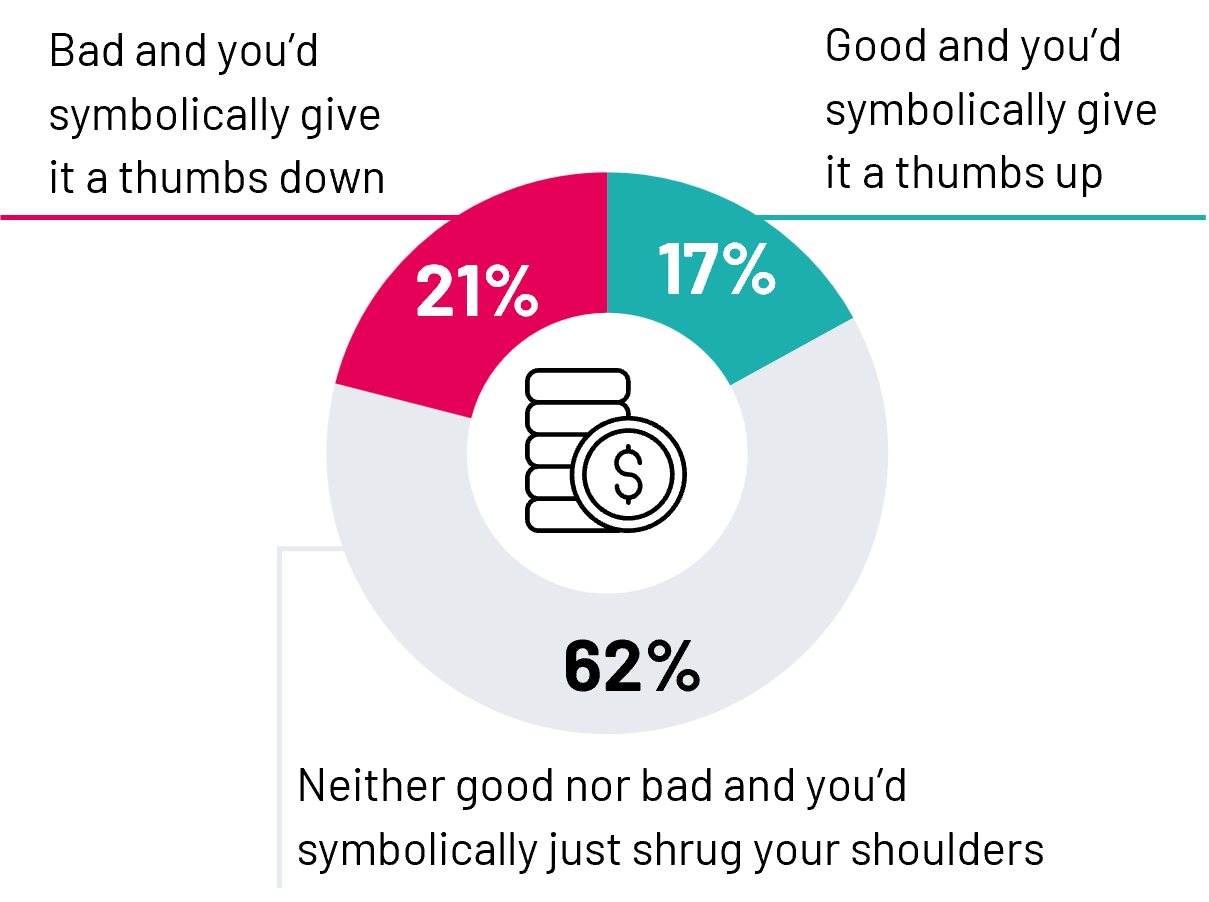
Despite the relative importance placed on the budget, Canadians’ assessment of it is ambivalent.  A majority of Canadians (62%) simply shrug their shoulders saying it is neither good nor bad. Two in ten (21%) would describe the budget as bad and symbolically give it a thumbs down, and a nearly equal proportion (17%) say it’s good and give it a thumbs up. Far more are neutral now than in early 2024, when disapproval was at 40%. Liberals have the most favourable impression of the budget although it is still relatively low, with 30% giving it a thumbs up and 6% giving it a thumbs down. Conservatives are less impressed as 9% give it a thumbs up and 43% give it a thumbs down. 

A majority of Canadians (62%) simply shrug their shoulders saying it is neither good nor bad. Two in ten (21%) would describe the budget as bad and symbolically give it a thumbs down, and a nearly equal proportion (17%) say it’s good and give it a thumbs up


Based on what you’ve seen, read or heard, do you think the budget will…
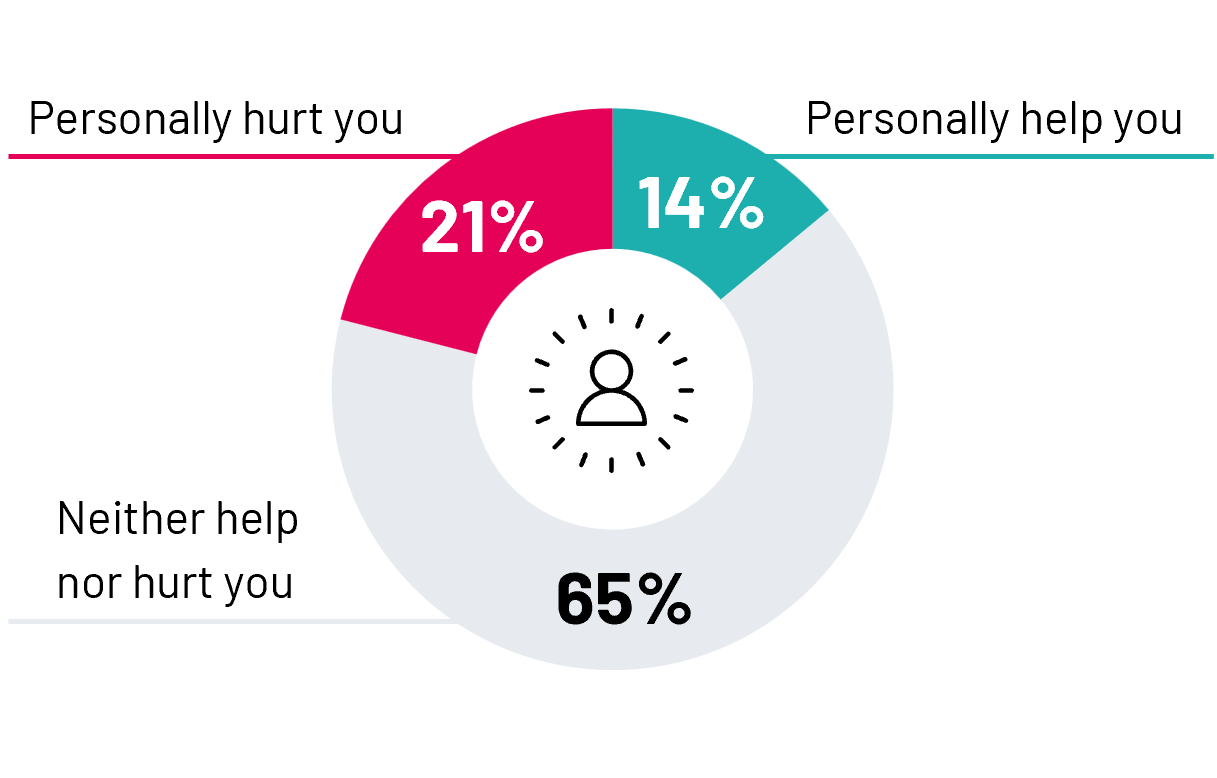
Relatively few believe the budget will help them (14%), while one in five (21%) believe it will personally hurt their finances. Liberals (21%) are most likely to believe the budget will help them, while Conservatives (42%) are most likely to think the budget will hurt them. 

Relatively few believe the budget will help them (14%), while one in five (21%) believe it will personally hurt their finances. Liberals (21%) are most likely to believe the budget will help them, while Conservatives (42%) are most likely to think the budget will hurt them.


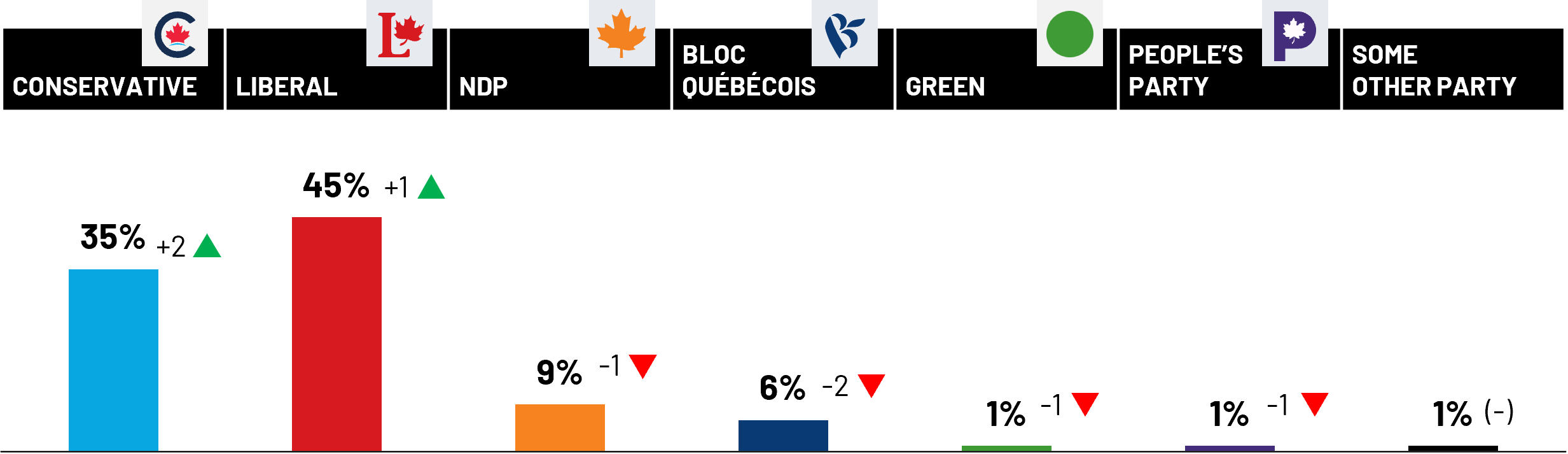
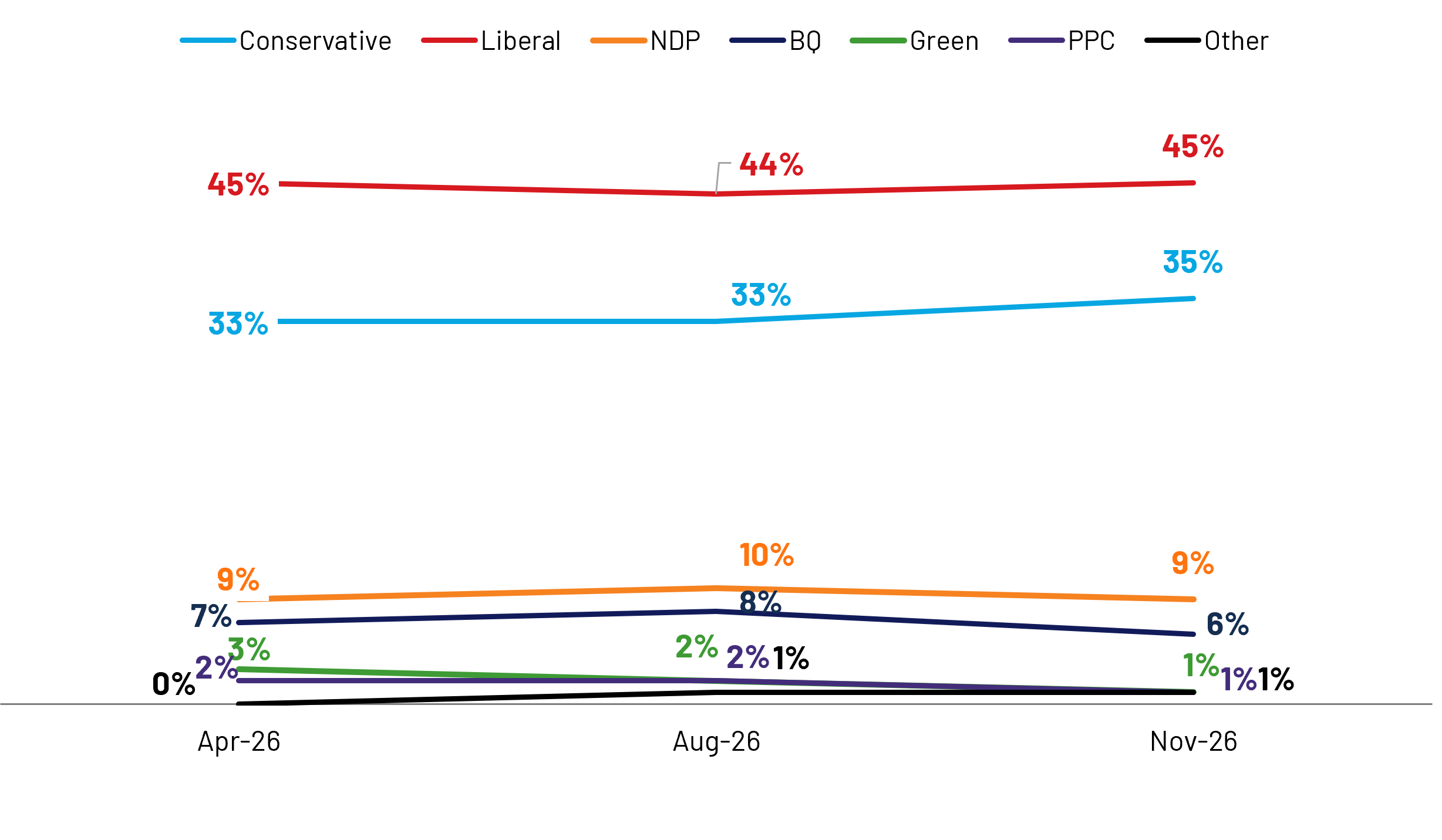
Federal VoteGiven the apparent apathy towards the budget, it’s perhaps not surprising that federal vote intentions are little changed since August. The Liberal party (45%, +1 pt vs. August 2026) would maintain its lead over the Conservatives (35%, +2 pts) among decided voters if an election were held tomorrow. The NDP would garner 9% of the popular vote (-1 pt), while the Bloc would garner 6% nationally (-2 pts), 26% in Quebec.


Given the apparent apathy towards the budget, it’s perhaps not surprising that federal vote intentions are little changed since August. The Liberal party (45%, +1 pt vs. August 2026) would maintain its lead over the Conservatives (35%, +2 pts) among decided voters if an election were held tomorrow. The NDP would garner 9% of the popular vote (-1 pt), while the Bloc would garner 6% nationally (-2 pts), 26% in Quebec.

The Liberals lead in all regions except Alberta, Saskatchewan and Manitoba and among Canadians of all income levels studied. However, the Conservatives (42%) lead the Liberals (34%) by eight points among Millennials. In contrast, the Liberals (61%) have a commanding 34-point lead over Conservatives (27%) among Boomers, who helped deliver Mark Carney his electoral victory in 2025. 
 

The Liberal party (45%, +1 pt vs. August 2026) would maintain its lead over the Conservatives (35%, +2 pts) among decided voters if an election were held tomorrow. The NDP would garner 9% of the popular vote (-1 pt), while the Bloc would garner 6% nationally (-2 pts), 26% in Quebec.


About the study

These are some of the findings of an Ipsos poll conducted between November 10 and 12, 2026, on behalf of Global News. For this survey, a sample of 1,002 Canadians aged 18+ was interviewed online. Quotas and weighting were employed to ensure that the sample’s composition reflects that of the Canadian population according to census parameters. The precision of Ipsos online polls is measured using a credibility interval. In this case, the poll is accurate to within ± 3.8 percentage points, 19 times out of 20, had all Canadians aged 18+ been polled. The credibility interval will be wider among subsets of the population. All sample surveys and polls may be subject to other sources of error, including, but not limited to coverage error, and measurement error.

For more information on this news release, please contact:

Darrell Bricker, PhD
Chairman, Ipsos Canada
+1 416 324 2001
[email protected]


About Ipsos

Ipsos is one of the largest market research and polling companies globally, operating in 90 markets and employing nearly 20,000 people.

Our passionately curious research professionals, analysts and scientists have built unique multi-specialist capabilities that provide true understanding and powerful insights into the actions, opinions and motivations of citizens, consumers, patients, customers or employees. Our 75 business solutions are based on primary data from our surveys, social media monitoring, and qualitative or observational techniques.

“Game Changers” – our tagline – summarizes our ambition to help our 5,000 clients navigate with confidence our rapidly changing world.

Founded in France in 1975, Ipsos has been listed on the Euronext Paris since July 1, 1999. The company is part of the SBF 120, Mid-60 indices, STOXX Europe 600 and is eligible for the Deferred Settlement Service (SRD).

http://www.ipsos.com/ 


Source link

Secretary of State van Koeverden and Minister Robertson announce Budget 2026 investments in community ice rinks and centres

0


The Government of Canada highlights Budget 2026 investments to build and upgrade ice rinks and community centres in Embrun and across the country


Source link

Parliamentary Secretary Chenette highlights Government of Canada’s investments from Budget 2026: Masters of our destiny

0


The Government of Canada highlights Budget 2026 investments that will help extend the life of aging facilities and ensure communities have modern, welcoming places to come together, compete, train and play


Source link

Parliamentary Secretary Chenette to highlight federal budget investments in community recreational facilities and ice rinks

0


The Government of Canada highlights key Budget 2026 investments in community recreational facilities and ice rinks.


Source link

Secretary of State van Koeverden and Minister Robertson to announce Budget 2026 investments in ice rinks and community centres

0


The Government of Canada is announcing key budget measures to build and upgrade ice rinks and community centres in Embrun and across the country.


Source link

Secretary of State van Koeverden announces major support through Budget 2026 to strengthen Canada’s wine sector

0


Through Budget 2026, the Government of Canada is supporting local wineries and independent grape growers as they adapt to economic and climate challenges. These investments will help protect and secure good jobs, boost agritourism across the country and build a stronger, more competitive Canadian wine industry


Source link

Secretary of State van Koeverden to announce Budget 2026 investments in Canada’s wine sector

0


The Government of Canada is announcing Budget 2026 measures to support local wineries — helping farm families and independent grape growers thrive by protecting and securing good jobs and boosting agritourism across the country.


Source link

Secretary of State van Koeverden announces Budget 2026 investments to make life more affordable for Canadians

0


The Government of Canada highlights Budget 2026 measures that will help Canadians manage the cost of living through targeted investments in food affordability, housing, energy, family services and income supports


Source link

Mitacs–Leibniz Association partnership expands opportunities for Canadian and German researchers

0
Mitacs–Leibniz Association partnership expands opportunities for Canadian and German researchers


About Mitacs

Mitacs delivers the return on innovation Canada needs now by connecting big ideas, people and ambition to turn potential into results. Through our co-funded innovation partnerships, we get Canada’s businesses and researchers where they need to go.

Mitacs partners innovate faster. Commercialize sooner. Compete globally. Scale and grow stronger. We open the door to opportunity, creating jobs and equipping students and postdoctoral researchers with skills, industry experience and professional networks.

A national not-for-profit organization founded in 1999, Mitacs is funded by the Government of Canada, the Government of Alberta, the Government of British Columbia, Research Manitoba, the Government of New Brunswick, the Government of Newfoundland and Labrador, the Government of Nova Scotia, the Government of Ontario, Innovation PEI, the Government of Quebec, the Government of Saskatchewan and the Government of Yukon.

About the Leibniz Association

The Leibniz Association brings together 96 independent research institutions across Germany, spanning the natural, life, engineering, environmental, economic, spatial, social, and human sciences. Leibniz institutes address issues of societal, economic, and environmental importance through both discovery-driven and applied research. They collaborate across disciplines in Leibniz research networks, operate and maintain major scientific infrastructures, and provide research-based services.

The Leibniz Association advises and informs policymakers, the scientific community, industry, and the broader public. It places particular emphasis on knowledge transfer, especially through the Leibniz research museums. A further priority is technologically relevant research and active technology transfer: Leibniz institutes work to translate innovative developments into practical application and, through close cooperation with business and industry, help bring new technologies into society.

Leibniz institutions maintain close partnerships with universities — including through the Leibniz ScienceCampi — as well as with industry and other partners in Germany and around the world. They are subject to a transparent and independent evaluation process.

Reflecting their national importance, the institutes of the Leibniz Association are jointly funded by the federal and state governments. Together, Leibniz institutes employ around 21,400 people, including 12,200 researchers, and have a total budget of more than €2.3 billion.


Source link