As announced in Budget 2026, the Government of Canada is providing important measures to support the audio and audiovisual sectors, and to protect access to public service media, productions from official language minority communities, Indigenous content, accessible programming, and local news.
Source link
Budget 2026: Masters of our Destiny – Minister Miller announces the rollout of $600 million targeted support to Canada’s audio and audiovisual sectors
Secretary of State van Koeverden and Minister Robertson announce Budget 2026 investments in community ice rinks and centres
The Government of Canada highlights Budget 2026 investments to build and upgrade ice rinks and community centres in Embrun and across the country
Source link
Secretary of State van Koeverden to announce Budget 2026 investments in Canada’s wine sector
The Government of Canada is announcing Budget 2026 measures to support local wineries — helping farm families and independent grape growers thrive by protecting and securing good jobs and boosting agritourism across the country.
Source link
Secretary of State van Koeverden and Minister Robertson to announce Budget 2026 investments in ice rinks and community centres
The Government of Canada is announcing key budget measures to build and upgrade ice rinks and community centres in Embrun and across the country.
Source link
Secretary of State van Koeverden to announce Budget 2026 affordability investments
The Government of Canada is announcing Budget 2026 measures to help lower housing, food and energy costs and provide more support for families.
Source link
Canadians See Federal Budget as More Important than U.S. Midterms


Canadians are more likely to believe the federal budget (44%) will have a bigger impact on Canada than the recent U.S. mid-term elections (24%), with the rest (33%) not knowing enough to say either way, according to a new Ipsos poll conducted for Global News. Despite the attention paid to the midterms and the Democratic victory in both houses of Congress and in many key gubernatorial races, across all regions of Canada, genders and generations, more believe the federal budget has a greater impact on Canada than the midterms. Conservatives (54%) are more likely than Liberals (42%) to view the federal budget as more important, while Liberals (30%) are more likely to think the midterms will be more impactful compared to just 22% of Conservatives.
As you may know, Finance Minister François-Philippe Champagne delivered the federal budget in the House of Commons on Thursday, November 5th. Based on what you have seen, read or heard about the budget, would you say that the budget overall is…
Despite the relative importance placed on the budget, Canadians’ assessment of it is ambivalent. A majority of Canadians (62%) simply shrug their shoulders saying it is neither good nor bad. Two in ten (21%) would describe the budget as bad and symbolically give it a thumbs down, and a nearly equal proportion (17%) say it’s good and give it a thumbs up. Far more are neutral now than in early 2024, when disapproval was at 40%. Liberals have the most favourable impression of the budget although it is still relatively low, with 30% giving it a thumbs up and 6% giving it a thumbs down. Conservatives are less impressed as 9% give it a thumbs up and 43% give it a thumbs down.
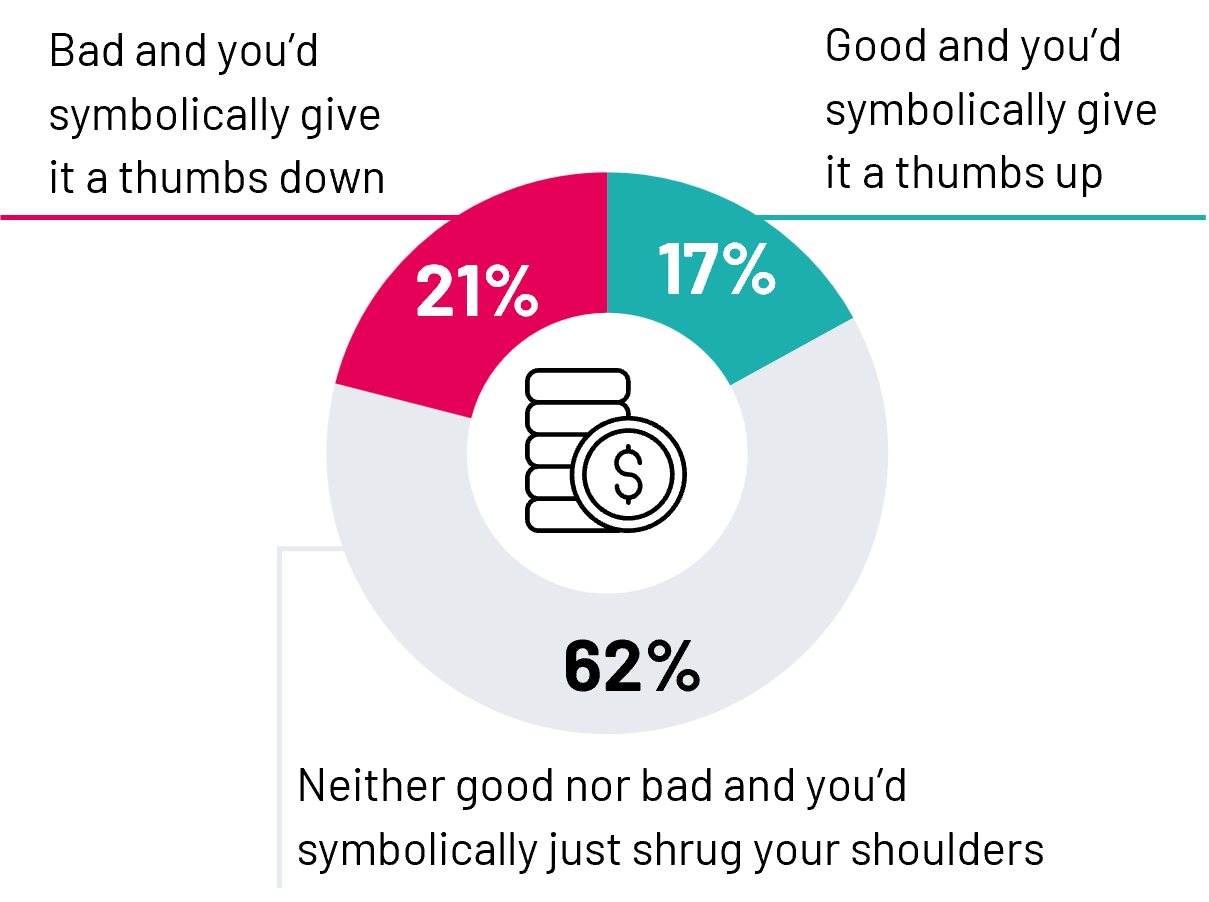
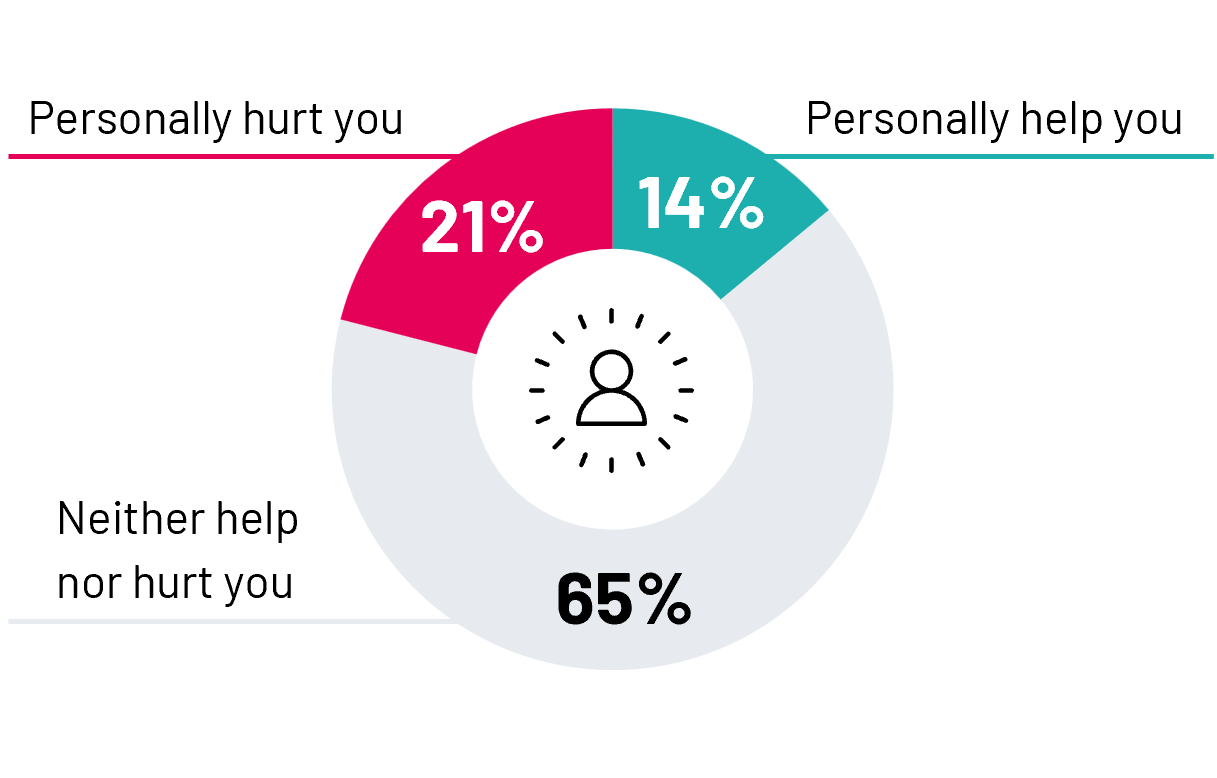
Based on what you’ve seen, read or heard, do you think the budget will…
Relatively few believe the budget will help them (14%), while one in five (21%) believe it will personally hurt their finances. Liberals (21%) are most likely to believe the budget will help them, while Conservatives (42%) are most likely to think the budget will hurt them.

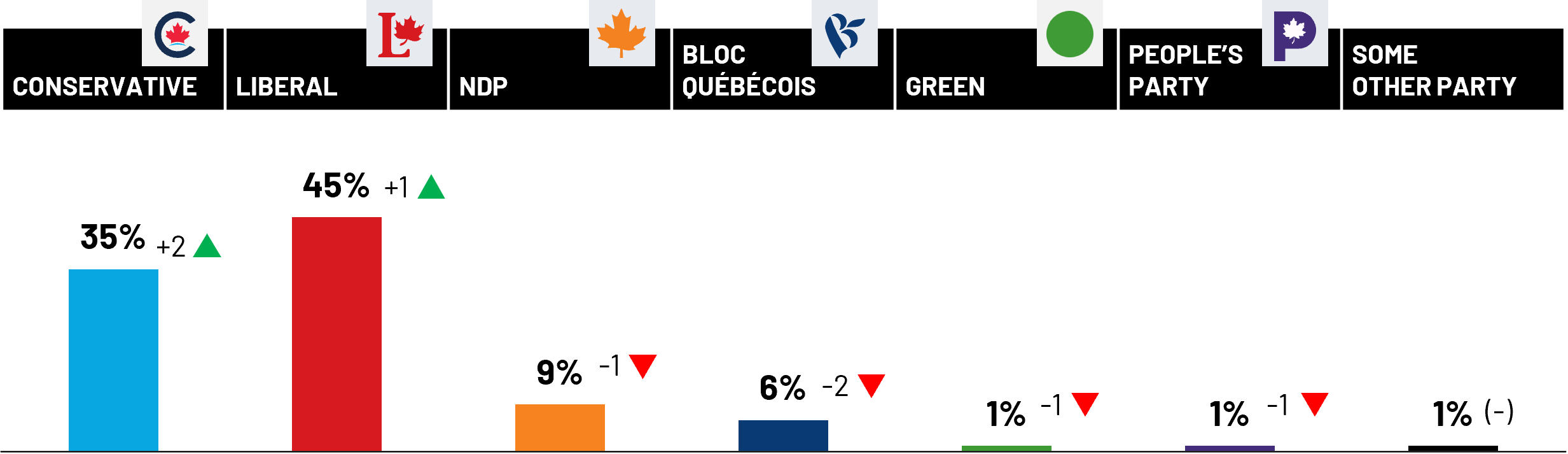
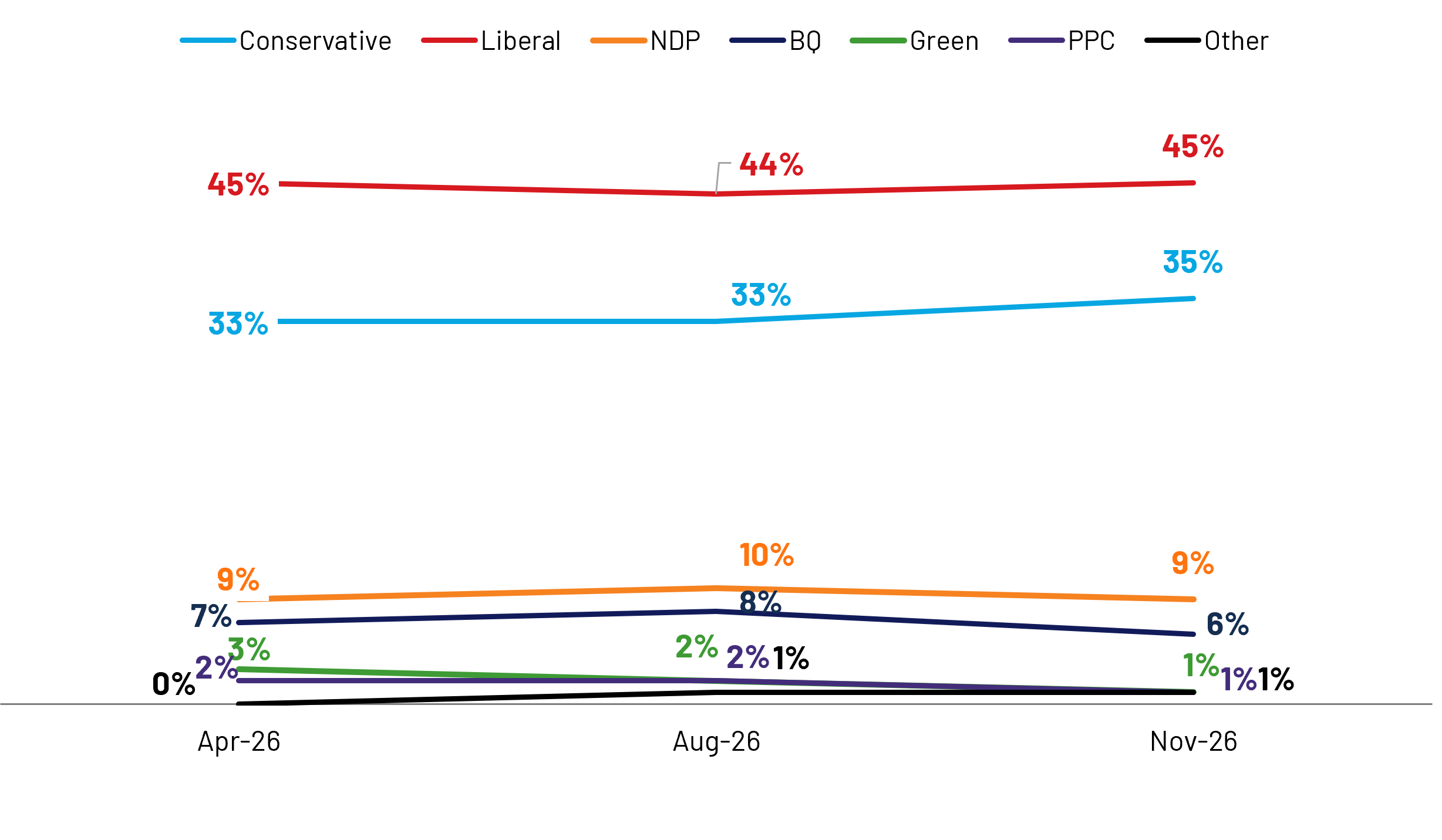
Given the apparent apathy towards the budget, it’s perhaps not surprising that federal vote intentions are little changed since August. The Liberal party (45%, +1 pt vs. August 2026) would maintain its lead over the Conservatives (35%, +2 pts) among decided voters if an election were held tomorrow. The NDP would garner 9% of the popular vote (-1 pt), while the Bloc would garner 6% nationally (-2 pts), 26% in Quebec.
The Liberals lead in all regions except Alberta, Saskatchewan and Manitoba and among Canadians of all income levels studied. However, the Conservatives (42%) lead the Liberals (34%) by eight points among Millennials. In contrast, the Liberals (61%) have a commanding 34-point lead over Conservatives (27%) among Boomers, who helped deliver Mark Carney his electoral victory in 2025.

These are some of the findings of an Ipsos poll conducted between November 10 and 12, 2026, on behalf of Global News. For this survey, a sample of 1,002 Canadians aged 18+ was interviewed online. Quotas and weighting were employed to ensure that the sample’s composition reflects that of the Canadian population according to census parameters. The precision of Ipsos online polls is measured using a credibility interval. In this case, the poll is accurate to within ± 3.8 percentage points, 19 times out of 20, had all Canadians aged 18+ been polled. The credibility interval will be wider among subsets of the population. All sample surveys and polls may be subject to other sources of error, including, but not limited to coverage error, and measurement error.
For more information on this news release, please contact:
Darrell Bricker, PhD
Chairman, Ipsos Canada
+1 416 324 2001
[email protected]

Ipsos is one of the largest market research and polling companies globally, operating in 90 markets and employing nearly 20,000 people.
Our passionately curious research professionals, analysts and scientists have built unique multi-specialist capabilities that provide true understanding and powerful insights into the actions, opinions and motivations of citizens, consumers, patients, customers or employees. Our 75 business solutions are based on primary data from our surveys, social media monitoring, and qualitative or observational techniques.
“Game Changers” – our tagline – summarizes our ambition to help our 5,000 clients navigate with confidence our rapidly changing world.
Founded in France in 1975, Ipsos has been listed on the Euronext Paris since July 1, 1999. The company is part of the SBF 120, Mid-60 indices, STOXX Europe 600 and is eligible for the Deferred Settlement Service (SRD).
We’re more bullish on Canadian innovation than ever
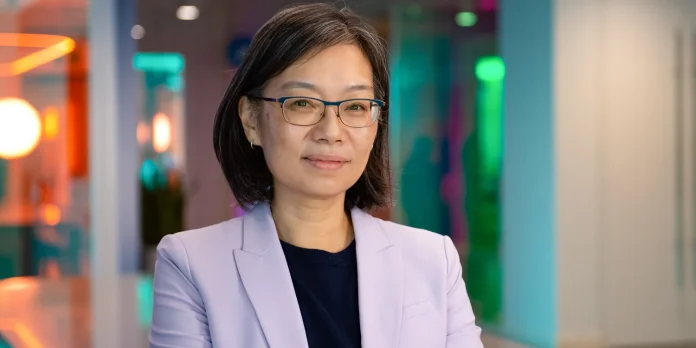
MaRS’s CEO, Grace Lee Reynolds, on our bright future.
In 2001, we were founded on the optimistic and bold belief in the power of Canadian innovation. While there’s been a lot of iteration over the last 25 years, our mission — helping entrepreneurs bring great ideas from the lab to the world — remains constant. Below, our CEO, Grace Lee Reynolds, muses on MaRS’s vital role in a mercurial world — and answers a few, somewhat more personal, bonus questions.
Stories from the ecosystem
The hottest jobs this week
Clearing the path
A facility that extracts critical mineral resources from mine tailings. A self-driving lab that expedites the discovery of life-saving medications. A platform that halves the energy consumed by large language models. These are the kinds of groundbreaking solutions in our orbit at MaRS.
We work with founders who are extraordinary problem-solvers. But it’s one thing to engineer a device or pinpoint a novel therapeutic; it’s a different battle to bring it to market. MaRS was founded to make that easier: Twenty-five years ago, physician and civic leader Dr. John Evans recognized Canada needed a place to incubate the best ideas in science and technology more than it needed another condo. Then, as now, the country’s innovators struggled to commercialize their innovations. He established MaRS to help clear obstacles so that we can all see the impact of their solutions faster.
I’ve been a MaRSian for the better part of the past decade and a half, and I still find myself marvelling at what a privilege it is to have a hand in shaping a better future. In 2011, I was flipping through The Globe and Mail and spotted a “finance director wanted” ad. (An ironically analog origin story for the CEO of a tech hub.) It was a very different time, for MaRS and for the world.
But in any ecosystem, the species that flourish are the ones that evolve and adapt to their surroundings. MaRS is no exception. The past quarter century has required constant iteration and recalibration of where our resources are most needed. Although MaRS remains committed to inclusive innovation with the twin goals of social impact and economic prosperity, it’s our agility and eagerness to meet the moment that have allowed us to thrive. The mercurial geopolitical landscape informs our sense of the role Canada plays within a broader system; the global market is integral to our pursuit of digital sovereignty and domestic growth. In turn, our understanding of the importance of place has expanded — catalytic connections can happen in the atrium of the MaRS Centre, online during a livestreamed panel or abroad during a market visit for one of our mission-based cohorts. We’re the spark that transfers that energy from node to node to node.
When I responded to that ad, I had only a vague notion of what MaRS was. But as I connected with MaRSians, it became apparent they shared a distinctive quality — a get-it-done pragmatism paired with a drive to pursue the loftiest dreams. That’s when I thought: Oh, my gosh, I really want to be part of this. That essence is still at the heart of the organization. We are resolute in our mission to help Canadian entrepreneurs make global impact while strengthening the foundations of our country.
As Mark Carney and François-Philippe Champagne say in the new federal budget, “Canada is turning global uncertainty into national opportunity.” This country, they add, is now “the best place in the world to invest.” There is still much work ahead to realize these ambitions. But with the world in flux, when accelerating change seems like the only constant, domestic innovation continues to be a powerful driver of progress. — Grace Lee Reynolds
Lightning round
We grilled our CEO on her fave things, dreams and predictions for the future.
What innovations most inspire you?
“So many do! Feats of physics and engineering like fusion machines and medical devices that help people maintain their independence. I’m equally inspired by systems-level innovation, like rethinking how we generate energy or reimagining elder care. Japan and Denmark have active and ambitious approaches — very different scales and challenges, but all driven by human ingenuity. It’s amazing what people can create when they agree to work together.”
Favourite cultural representation of the tech sector?
“Probably Halt and Catch Fire, which is really about people and partnerships.”
What’s your favourite spot at MaRS?
“Anywhere in the MaRS Centre atrium and the Lake Lounge at MaRS Waterfront. They’re both places where you’ll collide into conversations (and you can also sometimes hide in plain sight and get some work done).”
What innovation would make your life easier?
“Teleportation or memory multiplier.”
What new innovation would you like to see in the world?
“As a parent of three adult children, I deeply want to see more solutions that make the future feel promising to their generation and beyond. Cleaner energy, better health and dramatically lower costs so their future is affordable and sustainable.”
What will MaRS be working on in 2051?
“Problems that we haven’t imagined yet, with founders who are currently in kindergarten. I hope we will have helped make Canada a place where great companies can grow and stay.”
Stories from the ecosystem
INNOVATION: A moonshot idea: Calvin Stiller tells the story behind Canada’s largest innovation hub. (MaRS)
SECURITY: Budgeting for a stronger Canada. (Toronto Star)
GOVERNANCE: Introducing Barbara Stymiest, financial world icon and MaRS’s new board chair. (MaRS)
AI: Ada to merge with Dialpad in deal reportedly valuing firm at $600 million. (BetaKit)
FUNDING: Ottawa merging EDC and BDC and setting up a sovereign wealth fund. (Globe and Mail)
BIOTECH: Molly Shoichet’s groundbreaking research could improve treatments for diseases once thought irreversible. (BeGiant)
AI: The future of AI will be shaped by a few dozen people. (New York)
Solve for X: Automatic for the people

In a special bonus episode of the pod, Manjula Selvarajah chats with robot ethicist Jason Millar. It’s a lively, provocative conversation that raises a number of complicated questions: Should robots feel pain? What do we mean by trustworthy AI? And why is C-3PO so dang annoying?
Upcoming events
- MaRS’s Better Buildings: Hospitality and Recreation program, which helps owners and operators of hotels, motels and inns reduce expenses and increase efficiency, hosts an informational webinar on November 10.
- At this month’s Technically Speaking, “Get your story straight,” an expert panel — DECIEM’s Silvia Stanica, Neuraura’s Claire Dixon and MaRS’s Amanda Whalen — breaks down how a powerful brand narrative can transform the way your venture is seen by investors, partners, customers and talent. November 10.
- MaRS Climate Impact, featuring XPRIZE CEO Anousheh Ansari, Qikiqtaaluk Corporation president Harry Flaherty and General Fusion CEO Greg Twinney, among others, is November 17 and 18.
- On the second and final day of Climate Impact, MaRS’s First-of-a-Kind (FOAK) Lab hosts a venture showcase with Carbonova, Exterra Technologies, Green Graphite Technologies, Hyperion Global Energy and Planetary Technologies. November 18.
- The Canadian Disability Tech Summit, the national conference on assistive technology and disability innovation, is November 18.
- This year’s QueerTech Conference, “Who gets to trust AI? Power, participation and accountability,” is November 18 and 19.
- At the next MaRS Morning, “Designing for access: Women’s health equity,” Toronto Star health reporter Megan Ogilvie hosts a conversation with leaders in women’s health research about new innovations that target systemic healthcare inequities. November 26.
For more, visit our events page
In the queue: What we’re reading, watching and listening to at MaRS
Lee Cadesky is a food scientist, engineer and the author of Grub: Why We Eat, Why It Matters and the Seven Forces that Shape Our Food. She’s also the innovation director at Maple Leaf Foods and will be speaking at Climate Impact on November 17. This week, Cadesky shares her current obsessions.
 A Substack you’ll gobble up: “Snaxshot is the Variety of the food industry. It covers the business, the brands and the oddities of food in a way that’s actually fun to read. Written by Andrea Hernández, whom the New York Times dubbed ‘the Nostradamus of snacking.’”
- A forum for Freudian foodies: “r/somnigastronomy is a subreddit where people post, discuss, make and eat the food they see in their dreams. It’s a reminder of what food creativity can be when nobody is worrying about real life. Completely unhinged, in the best way.”
- The clotheshorse’s fave podcast: “Avery Trufelman’s Articles of Interest, a show about the social history of what we wear, is a surprisingly good listen for anyone in food. Or maybe not that surprising. Food and fashion share many of the same challenges and origins: agriculture and fibre production, military development, circularity and sustainability, and shifting consumer trends.”
- A deep dive into food innovation: “In Jasper Is Hungry, Jasper Sturtwagen covers a wide range of food tech topics. The highlight for me is his Friday round-up of recent food patent applications — a great window into where food innovation is headed.”
Careers: The hottest jobs in tech this week
- Wattpad, the webnovel platform, is hiring for several positions at its WEBTOON Entertainment division, including a senior accountant, a global brand marketing manager and an associate visual designer. (Multiple cities)
- CoLab Software, whose AI platform helps coordinate engineering teams, is hiring a manager of industry partnerships, a mechanical engineer and various other positions. (Multiple cities)
- PhenoTips, a software company developing solutions for clinical genetics, is looking for a senior devops and backend software engineer, a senior full-stack software developer and a senior technical delivery manager. (Toronto)
- Axine Water Technologies, which develops wastewater treatment technologies, is hiring an assembly coordinator and a production project manager. (Vancouver)
For more, visit our jobs page
Did you know that MaRS is a charity?
Your support helps us advance Canadian innovation and science, bring our community together and transform the world for the better. For instance, through our carbon removal donation program, you can help support Canada’s most promising CDR companies through tax-deductible donations. Learn more here.
Thanks for reading! See you in two weeks.
Sign up for our newsletter
What Retailers Need to Know

Retailers have spent years investing in visibility through search rankings, advertising, optimized websites and memorable in-store experiences. Those investments remain important, but AI introduces another layer between a shopper’s need and the brands they encounter.
A consumer searching for hiking boots can now describe their budget, experience level and preferred terrain in a single conversation. Instead of browsing a dozen products, they can ask AI to compare the trade-offs and recommend a few options worth considering.
Our findings suggest the starting point is already shifting. 18% of Canadians now turn to AI first when searching for information online, up from 4% in 2024. Among AI users, 56% say they use traditional search engines less, 34% use brand websites less and 27% use retailer websites less. These are self-reported changes in behaviour, not a direct measure of website traffic, but they point to a different route to discovery.
The competitive challenge is shifting from being easy to find to being relevant enough to be recommended by AI. A brand can have a polished website and still be absent from a recommendation if its products are difficult to understand or compare in the information AI can access.
For retail teams, product content is therefore more than a merchandising detail. Accurate specifications, clear differentiators, current prices and credible reviews help both shoppers and AI tools assess fit. Google’s guidance for AI-era commerce similarly emphasizes detailed, accurate product information. The goal isn’t to chase a guaranteed place in an AI answer, but to make the brand easier to evaluate when a shopper asks a specific question.
Parliamentary Secretary David Myles to highlight Budget 2026 investments in culture
The Government of Canada will highlight Budget 2026 investments in culture in Fredericton
Source link
Want Canadian life sciences anchor companies? Start by building the pipeline.

Validate, incubate, accelerate. Repeat.
By Matthew Carlyle, President and CEO, adMare BioInnovations
At Western University, David Edgell developed a breakthrough that could change how we tackle diseases at their genetic source. First-generation gene editors are good at breaking genes, but not repairing them. Edgell’s unique approach uses an enzyme that makes two precise cuts instead of one, creating the potential to target disease-causing genetic errors more accurately while reducing unintended effects. It is the kind of breakthrough that opens new possibilities for diseases where the underlying genetic cause remains beyond our reach.
Today, Edgell’s discovery is the foundation of Specific Biologics, a Toronto company that is progressing towards Series A financing to advance its lead program for amyotrophic lateral sclerosis, or ALS, into a first-in-human clinical trial. For patients, the stakes are enormous. ALS is a devastating disease that takes away a person’s ability to move, speak, swallow and eventually breathe. Current treatments do not address the underlying genetic cause. Specific Biologics is initially targeting the most common genetic form of ALS, caused by a harmful DNA repeat expansion that its Dualase® gene-editing platform is designed to remove.
This is what success looks like: Canadian science built into a Canadian company that delivers meaningful new treatments for patients and is backed by Canadian investors who keep more value here at home. If we are serious about building globally competitive anchor companies, these are the examples we need to replicate at scale.
Building domestic innovative pharmaceutical anchor companies is something adMare Bioinnovations has long championed, and is a central goal of the Pharmaceutical and Life Sciences Sector Task Force recommendations. The Task Force estimates that just two or three anchor companies could generate $5 to $10 billion in annual revenue and more than 10,000 jobs. With supply chains and trade relationships shifting, this matters for both health and economic security.
However, anchor companies don’t appear overnight. They grow from a deep pipeline of investable Canadian companies.
Right now, that pipeline is under pressure. Canadian life sciences venture capital recorded its worst half on record in 2026. Globally, biotech is concentrating in fewer, larger, and more de-risked deals – creating a growing funding gap for early-stage companies. Compounding the challenge, Canada’s conversion gap between pre-seed/seed and Series A financing has been widening since 2021. In other words, we are creating companies, but too few are making it to the next stage.
Building an investable life sciences company is complex and capital intensive. It requires experienced drug developers who understand both the science and the commercial opportunity, along with the expertise, hands-on support and early capital to prove the technology, reach critical development milestones and attract larger private investment.
The good news is we already know how to do this.
Over the last decade, the federal government has partnered with adMare, a national engine for life science company creation and growth with operations in Montreal, Vancouver and Toronto. Their model is straightforward – collaborate with Canadian researchers and institutions, validate the science and commercial potential, incubate the company through early development, and accelerate growth through continued investment. Then, re-invest returns to do it again.
Specific Biologics shows the model in action. Over five years, adMare worked alongside its founders to turn promising science into an investable company – building its R&D strategy, co-leading seed financing with Lumira Ventures to execute it, and providing hands-on research and operational support needed to develop the technology, build the team, and attract Series A investment.
This is not an isolated example. Of the 31 companies that have been part of adMare’s direct investment portfolio, 16 have crossed the “valley of death” and raised substantial private risk capital, a conversion rate roughly three times the Canadian average and comparable to leading U.S. benchmarks.
This supply of investment-ready companies is critical. Government is already advancing several downstream tools to support company scaling, including BDC’s new Life Sciences Fund and the Growth Venture Capital Catalyst Initiative. Their success will depend on a continual supply of investment-ready Canadian companies to fund. Two-thirds of adMare’s portfolio are already backed by leading Canadian life science venture investors. This, along with adMare’s significant investments in national lab infrastructure and talent development programs, help to root growth here at home.
adMare offers exactly the kind of approach the Task Force recommends expanding to support the early commercialization journey, and for good reason: the return on public capital is compelling. Since 2017, adMare has invested more than $120 million of federally supported capital into companies across the country with every dollar leveraged 14 times with capital from private investors, exceeding targets. In total, these companies have raised $2.5 billion in private risk capital. The portfolio has also generated significant realized returns that have been fully reinvested to build the next generation of Canadian companies.
As Ottawa prepares its budget and its response to the Task Force, its commercialization measures should start where anchor companies begin. A five-year, $200 million investment in adMare’s proven model would strengthen the pipeline now, while future investment returns can help sustain it over the long term.
Not every company will become an anchor company. However, building more companies with deep domestic foundations, like Specific Biologics, the better our odds.
Canada won’t get its anchor companies by waiting for them to appear. It will get them by building the pipeline that produces them. We have the science. We have the model. The opportunity is in front of us: turn more Canadian science into Canadian companies that change patients’ lives around the world and build prosperity here at home.