The Government of Canada highlights Budget 2026 investments that will help extend the life of aging facilities and ensure communities have modern, welcoming places to come together, compete, train and play
Source link
Parliamentary Secretary Chenette highlights Government of Canada’s investments from Budget 2026: Masters of our destiny
Secretary of State van Koeverden to announce Budget 2026 investments in Canada’s wine sector
The Government of Canada is announcing Budget 2026 measures to support local wineries — helping farm families and independent grape growers thrive by protecting and securing good jobs and boosting agritourism across the country.
Source link
Canadians See Federal Budget as More Important than U.S. Midterms


Canadians are more likely to believe the federal budget (44%) will have a bigger impact on Canada than the recent U.S. mid-term elections (24%), with the rest (33%) not knowing enough to say either way, according to a new Ipsos poll conducted for Global News. Despite the attention paid to the midterms and the Democratic victory in both houses of Congress and in many key gubernatorial races, across all regions of Canada, genders and generations, more believe the federal budget has a greater impact on Canada than the midterms. Conservatives (54%) are more likely than Liberals (42%) to view the federal budget as more important, while Liberals (30%) are more likely to think the midterms will be more impactful compared to just 22% of Conservatives.
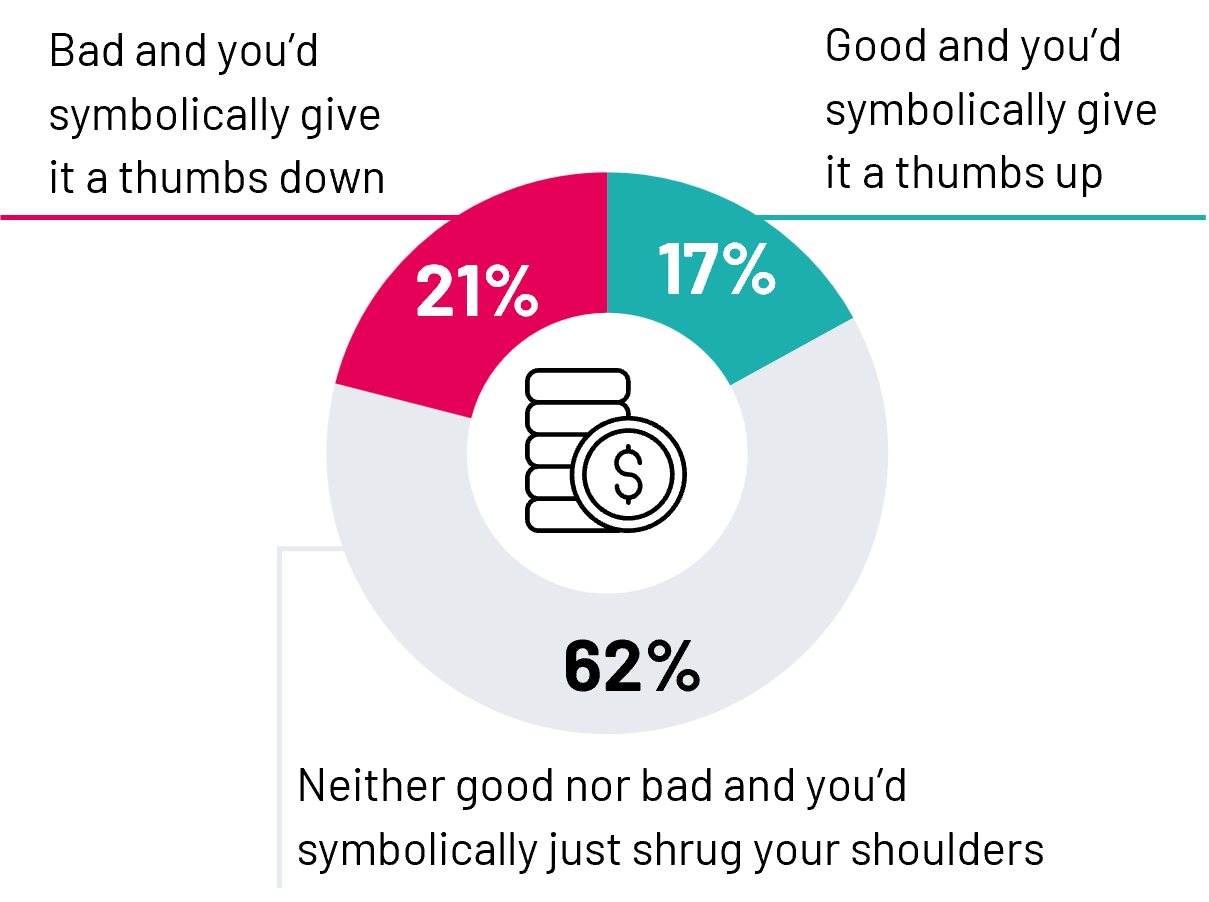
As you may know, Finance Minister François-Philippe Champagne delivered the federal budget in the House of Commons on Thursday, November 5th. Based on what you have seen, read or heard about the budget, would you say that the budget overall is…
Despite the relative importance placed on the budget, Canadians’ assessment of it is ambivalent. A majority of Canadians (62%) simply shrug their shoulders saying it is neither good nor bad. Two in ten (21%) would describe the budget as bad and symbolically give it a thumbs down, and a nearly equal proportion (17%) say it’s good and give it a thumbs up. Far more are neutral now than in early 2024, when disapproval was at 40%. Liberals have the most favourable impression of the budget although it is still relatively low, with 30% giving it a thumbs up and 6% giving it a thumbs down. Conservatives are less impressed as 9% give it a thumbs up and 43% give it a thumbs down.
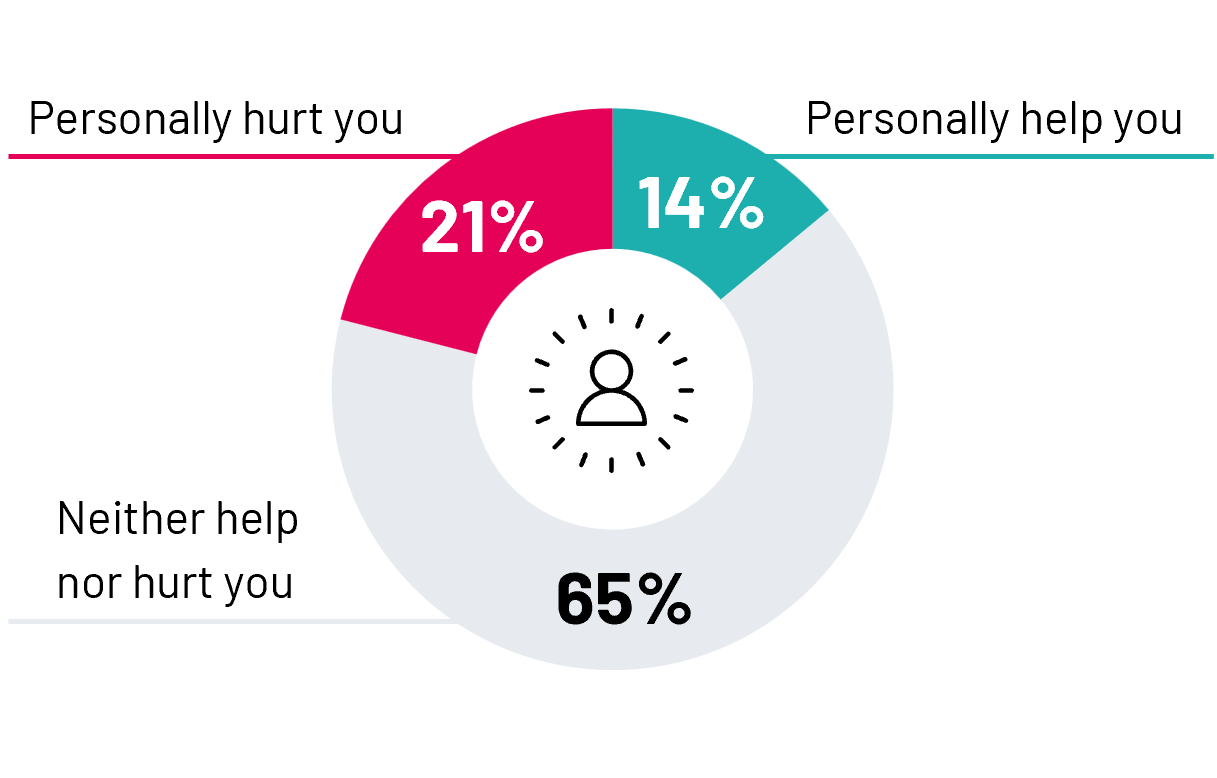
Based on what you’ve seen, read or heard, do you think the budget will…
Relatively few believe the budget will help them (14%), while one in five (21%) believe it will personally hurt their finances. Liberals (21%) are most likely to believe the budget will help them, while Conservatives (42%) are most likely to think the budget will hurt them.

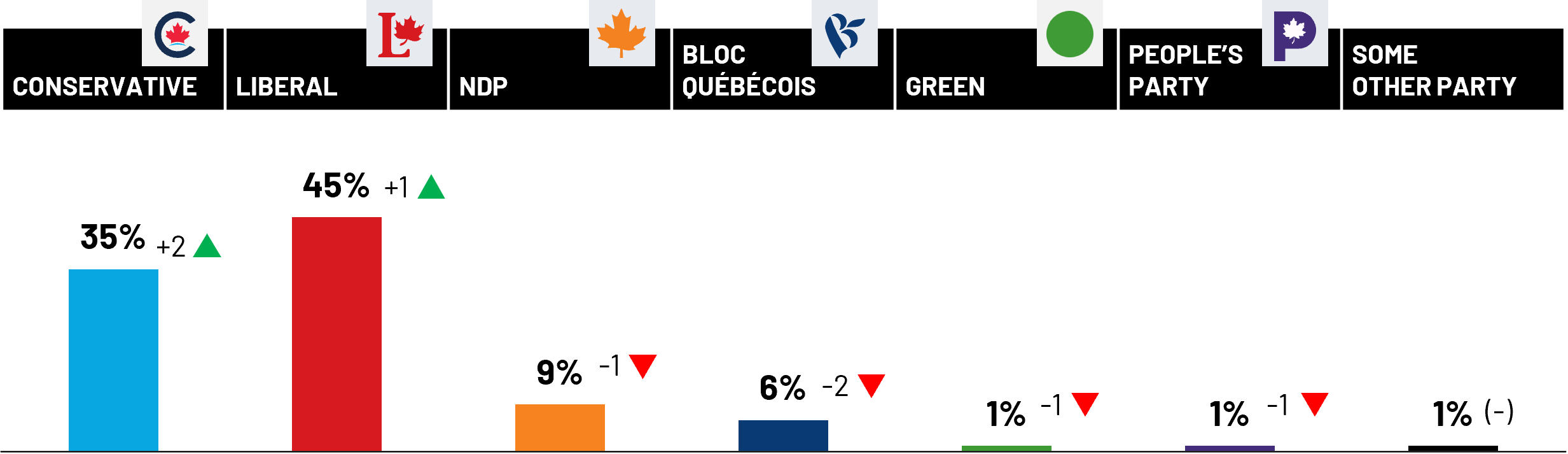
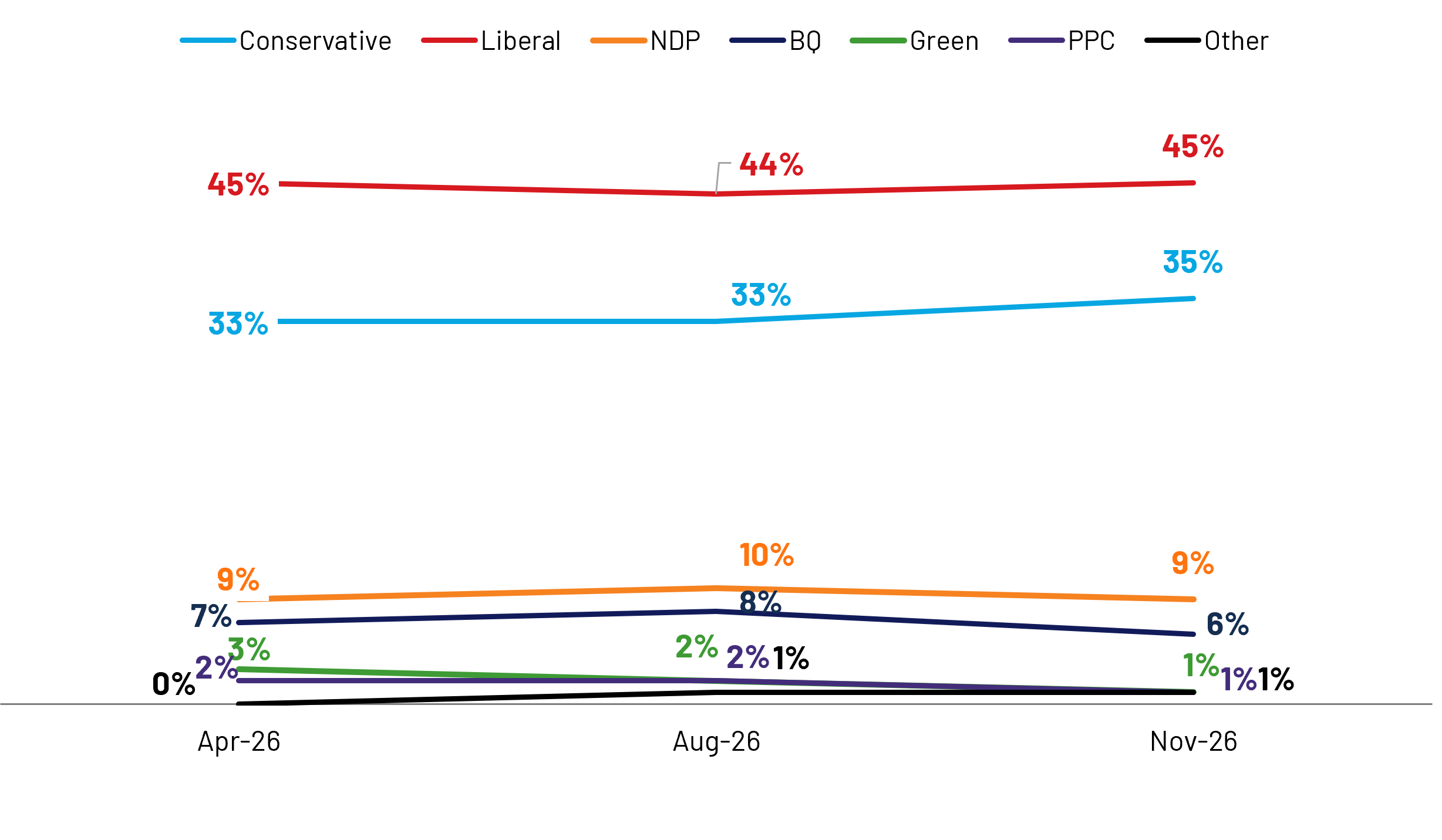
Given the apparent apathy towards the budget, it’s perhaps not surprising that federal vote intentions are little changed since August. The Liberal party (45%, +1 pt vs. August 2026) would maintain its lead over the Conservatives (35%, +2 pts) among decided voters if an election were held tomorrow. The NDP would garner 9% of the popular vote (-1 pt), while the Bloc would garner 6% nationally (-2 pts), 26% in Quebec.
The Liberals lead in all regions except Alberta, Saskatchewan and Manitoba and among Canadians of all income levels studied. However, the Conservatives (42%) lead the Liberals (34%) by eight points among Millennials. In contrast, the Liberals (61%) have a commanding 34-point lead over Conservatives (27%) among Boomers, who helped deliver Mark Carney his electoral victory in 2025.

These are some of the findings of an Ipsos poll conducted between November 10 and 12, 2026, on behalf of Global News. For this survey, a sample of 1,002 Canadians aged 18+ was interviewed online. Quotas and weighting were employed to ensure that the sample’s composition reflects that of the Canadian population according to census parameters. The precision of Ipsos online polls is measured using a credibility interval. In this case, the poll is accurate to within ± 3.8 percentage points, 19 times out of 20, had all Canadians aged 18+ been polled. The credibility interval will be wider among subsets of the population. All sample surveys and polls may be subject to other sources of error, including, but not limited to coverage error, and measurement error.
For more information on this news release, please contact:
Darrell Bricker, PhD
Chairman, Ipsos Canada
+1 416 324 2001
[email protected]

Ipsos is one of the largest market research and polling companies globally, operating in 90 markets and employing nearly 20,000 people.
Our passionately curious research professionals, analysts and scientists have built unique multi-specialist capabilities that provide true understanding and powerful insights into the actions, opinions and motivations of citizens, consumers, patients, customers or employees. Our 75 business solutions are based on primary data from our surveys, social media monitoring, and qualitative or observational techniques.
“Game Changers” – our tagline – summarizes our ambition to help our 5,000 clients navigate with confidence our rapidly changing world.
Founded in France in 1975, Ipsos has been listed on the Euronext Paris since July 1, 1999. The company is part of the SBF 120, Mid-60 indices, STOXX Europe 600 and is eligible for the Deferred Settlement Service (SRD).
Federal Government Seeks to Boost Resilience, Private Investment, and Affordability in Budget 2026

In a time of “rupture,” the traditional underpinnings of budget making and economic policy have been challenged. In his pre-budget tour, Finance Minister Francois-Philippe Champagne pledged that the government intends to “change Canada’s growth model” as the country enters “this period of global change from a position of strength.”
Masters of our Destiny, Budget 2026, lays out the federal government’s next steps to advance its priorities through measures focused on stimulating private investment, accelerating major infrastructure and energy projects, strengthening defence and sovereignty, and improving affordability. Budget 2026 also lays out the government’s 2027–2029 Immigration Levels Plan, which maintains reduced targets.
Opposition leaders have challenged the budget’s priorities. Conservative Leader Pierre Poilievre stated in his response that “the single job of this budget should have been to save Canadians money, and you don’t do that by adding $765 billion of debt on the backs of Canadians.”
NDP leader Avi Lewis dismissed it as a budget for billionaires that “does little to actually lower [Canadians’] costs.”
The Bloc stated that the budget did not address the demands of the Quebec government related to health transfers and asylum seekers.
1) Spending in a Challenging and Volatile Time
Why it matters: Canada faces a tricky situation with implications for the government’s balance sheet and next steps: a lingering trade war, slow economic growth, higher bond yields and borrowing costs, and elevated gas prices caused by the war in Iran. This translates to greater costs for households but higher revenues for government.
While Tuesday’s U.S. election led to the Democrats taking control of the House of Representatives and the Senate, the changing of the guard in Congress does not guarantee a smooth outcome on trade if the past is any guide.
By the numbers:
- Budget 2026 forecasts lower deficits compared to the last Spring Economic Update (SEU). The 2026/2027 deficit has been adjusted to $62.3 billion, down from $65.3 billion in the SEU
- Total expenses for 2026/2027 are forecasted at $602.6 billion while budgetary revenues will come in at $540.3 billion
- The government anticipates balancing its operating budget in 2027/28, a year early compared to last year’s projections
The bottom line: Canada’s fiscal approach seeks to signal sustainability while investing in growth, productivity, and long-term resilience. But spending at this level may be unsustainable if growth falls short or investment returns are delayed, with elevated borrowing costs making the strategy harder to sustain.
2) Seeking to Enable Business Growth and Investment with a Suite of Measures
Why it matters: In the leadup to Budget 2026, Minister Champagne signalled that efforts to stimulate private investment and improve productivity would extend beyond large corporations.
Budget 2026 outlines a suite of tax incentives, financial supports, and regulatory reforms intended to help businesses invest, innovate, and expand. These measures seek to strengthen Canada’s competitiveness, encourage domestic reinvestment, and support business growth amid continued trade uncertainty.
The details: The budget emphasizes that Canada’s marginal effective tax rate on new business investment will fall from 13% to 6.4%, encouraging businesses to invest, expand, and increase productivity. Other measures include:
- Establishing the Canada Growth Incentive, aimed at helping businesses attract investment, scale, and keep capital in Canada through a new tax exemption on up to $15 million in capital gains from eligible investments and an enhanced small business rollover
- Investing $930 million to expand the SR&ED tax incentive program to include certain commercialisation expenses
- Investing $1 billion into the Strategic Response Fund to support large-scale R&D projects
The bottom line: Prime Minister Carney is betting that private investment incentives will boost growth and strengthen Canadian businesses amid trade tensions. With opposition parties focused on affordability and spending, the Liberals must ensure these incentives benefit small businesses, workers, and communities—not just large corporations.
3) The Politics of Affordability
Why it matters: As high grocery and gas prices linger and interest rates begin rising again, affordability remains top of mind for Canadians. Opposition parties are looking to capitalise on these concerns by focusing on cost-of-living issues.
In response to the pressures faced by Canadians, Budget 2026 outlines how the government intends to address affordability challenges faced by Canadian households and frames these actions as a “boost today and a bridge to a better tomorrow.”
The details:
- Creating the 2027 Canada Groceries and Essentials Benefit Supplement, a 50% top up to the Canada Groceries and Essentials Benefit, means a family of four will receive up to $2,570, delivered in early 2027
- Introducing the Build Canada Workers Benefit, a top-up to the existing Canada Workers Benefit, to provide up to $1,859 for individuals and $3,143 for families
- Renewing the Canada Housing Benefit for 10 years ($1.7 billion over 3 years, starting in 2028-29, and $3.9 billion in future years), providing direct monthly rental assistance to low-income Canadians
- $2 billion towards home retrofits to save homeowners an estimated $1 billion per year in heating and cooling costs
The bottom line: The results of the U.S. midterms is a stark reminder of the political perils of ignoring affordability concerns. With six by-elections on December 7, the Liberals need to demonstrate that targeted relief to improve affordability is coming.
4) Building Strong for the Future
Why it matters: Against a backdrop of trade uncertainty and efforts to strengthen Canada’s economic competitiveness, the Liberals have made nation-building projects a central pillar of their economic agenda.
Budget 2026 builds on this with major investments in energy, housing, and infrastructure aimed at creating jobs and driving long-term economic prosperity.
The details:
- An investment of $45 billion to build homes faster and more efficiently using modern methods of construction and Canadian inputs and labour
- Over $50 billion to double Canada’s electricity supply by 2050, including investments in nuclear, hydroelectricity, transmission infrastructure, and measures for Canadians and industry to lower energy costs
- $25 billion over three years to seed the Canada Strong Fund, Canada’s first sovereign wealth fund, which will operate as an arm’s-length and standalone Crown corporation
The bottom line: Attracting new industries and long-term investment requires reliable electricity, housing, and transportation networks. The Liberals must now turn ambition into delivery: start construction, create jobs, and show their nation-building agenda can generate lasting prosperity.
What Comes Next
The Budget motion “that the House approves in general the budgetary policy of the government” allows up to four days of debate.
Debate is likely to conclude by the end of the week of November 16, with votes on a Conservative amendment and a Bloc Quebecois sub-amendment.
If the government moves quickly, debate could conclude by November 18. The House does not sit the week of November 9 for Remembrance Day.
The government will then introduce a Budget Implementation Act (BIA) to enact the budget’s legislative and tax measures. Given the parliamentary schedule and the priority placed on the Building Canada Act (C-39) and the Strengthening Canada’s Defence Sector Act (C-40), the BIA is unlikely to pass all three readings in the House of Commons before spring 2027.
Secretary of State van Koeverden announces Budget 2026 investments to make life more affordable for Canadians
The Government of Canada highlights Budget 2026 measures that will help Canadians manage the cost of living through targeted investments in food affordability, housing, energy, family services and income supports
Source link
What Retailers Need to Know

Retailers have spent years investing in visibility through search rankings, advertising, optimized websites and memorable in-store experiences. Those investments remain important, but AI introduces another layer between a shopper’s need and the brands they encounter.
A consumer searching for hiking boots can now describe their budget, experience level and preferred terrain in a single conversation. Instead of browsing a dozen products, they can ask AI to compare the trade-offs and recommend a few options worth considering.
Our findings suggest the starting point is already shifting. 18% of Canadians now turn to AI first when searching for information online, up from 4% in 2024. Among AI users, 56% say they use traditional search engines less, 34% use brand websites less and 27% use retailer websites less. These are self-reported changes in behaviour, not a direct measure of website traffic, but they point to a different route to discovery.
The competitive challenge is shifting from being easy to find to being relevant enough to be recommended by AI. A brand can have a polished website and still be absent from a recommendation if its products are difficult to understand or compare in the information AI can access.
For retail teams, product content is therefore more than a merchandising detail. Accurate specifications, clear differentiators, current prices and credible reviews help both shoppers and AI tools assess fit. Google’s guidance for AI-era commerce similarly emphasizes detailed, accurate product information. The goal isn’t to chase a guaranteed place in an AI answer, but to make the brand easier to evaluate when a shopper asks a specific question.
Secretary of State van Koeverden and Minister Robertson to announce Budget 2026 investments in ice rinks and community centres
The Government of Canada is announcing key budget measures to build and upgrade ice rinks and community centres in Embrun and across the country.
Source link
What Retailers Need to Know

Retailers have spent years investing in visibility through search rankings, advertising, optimized websites and memorable in-store experiences. Those investments remain important, but AI introduces another layer between a shopper’s need and the brands they encounter.
A consumer searching for hiking boots can now describe their budget, experience level and preferred terrain in a single conversation. Instead of browsing a dozen products, they can ask AI to compare the trade-offs and recommend a few options worth considering.
Our findings suggest the starting point is already shifting. 18% of Canadians now turn to AI first when searching for information online, up from 4% in 2024. Among AI users, 56% say they use traditional search engines less, 34% use brand websites less and 27% use retailer websites less. These are self-reported changes in behaviour, not a direct measure of website traffic, but they point to a different route to discovery.
The competitive challenge is shifting from being easy to find to being relevant enough to be recommended by AI. A brand can have a polished website and still be absent from a recommendation if its products are difficult to understand or compare in the information AI can access.
For retail teams, product content is therefore more than a merchandising detail. Accurate specifications, clear differentiators, current prices and credible reviews help both shoppers and AI tools assess fit. Google’s guidance for AI-era commerce similarly emphasizes detailed, accurate product information. The goal isn’t to chase a guaranteed place in an AI answer, but to make the brand easier to evaluate when a shopper asks a specific question.
Is the Economy Shaping the Project, or Justifying It? – CPCS

Is the Economy Shaping the Project, or Justifying It?

Choosing infrastructure around what producers need to compete
I have spent most of my career preparing infrastructure projects, producing studies and reviewing work prepared by others. In some assignments, the client was looking for demand forecasts that would justify a project it had already chosen. A port needs cargo, a railway needs freight and an industrial zone needs tenants. The temptation is to treat the volumes required to make the project viable as the demand it is likely to attract.
World Bank guidance on toll-road PPPs identifies political and commercial pressures involving both awarding authorities and bidders. Where procurement rewards high traffic forecasts without adequately testing their realism, it can place “substantial pressure on the traffic forecaster to produce sufficiently optimistic forecasts”. These incentives help explain how the commercial objective can start to shape the demand assumptions.
The consequences may emerge years later, when the infrastructure is built but the expected volumes fail to materialise. Depending on the contractual arrangements, users may face higher tariffs, the government may have to cover a shortfall, or investors and lenders may incur losses. Reaching financial close does not make the demand appear.
Calculating the volume a project needs to be viable is useful work, but it is not a demand forecast. A forecast needs evidence about the firms or users expected to generate demand, and a client’s determination to reach financial close cannot supply it. Even a sound forecast, however, does not settle the investment choice. Firms may expect to use a new port because it offers a better service, while their main obstacle to competing lies elsewhere. The appraisal must therefore establish how much the port would improve their competitiveness and whether another intervention would achieve more.
In the first article of this series, I proposed a test: describe what a project is for without naming the asset. “Build a port” does not say what economic result we are trying to produce. “Make processed cashew competitive in a defined export market” begins to. Once the asset has been named, can the economic analysis still change it?
This article focuses on infrastructure investments justified by the production, trade or industrial development they are expected to support, whether publicly or privately financed. Access to essential services and territorial cohesion are also legitimate objectives, and investments serving them must be assessed against those objectives.
Four propositions carry the rest of this article:
- Before choosing infrastructure to support production, establish what firms intend to produce, for which markets and with what service requirements.
- Compare how much each investment would improve producers’ ability to compete, and at what cost.
- Different processing stages require different infrastructure, whose cost and reliability can affect which activities are viable.
- Under uncertainty, distinguish what can proceed now, what depends on specific conditions being met, and which options are worth preserving for later.
Identify the constraints holding production back
A damaged road or an unreliable electricity supply may justify attention, but deciding where to invest requires understanding how these problems affect production. Sector policy can identify the activities a country wants to develop. Infrastructure planning should test which services those activities need and where investment would make the greatest difference. The findings may also lead the country to reconsider its original production ambitions.
Public authorities and their advisers should work with producers and prospective buyers to understand what prevents firms from winning or fulfilling orders. Transport costs may be one obstacle; unreliable power, product standards or access to working capital may be others. Discussions with businesses, supported by available data and comparisons with competing suppliers, can help identify which constraints infrastructure could address. Where production is still only an ambition, the analysis must examine what would make firms invest.
The proposed project should then be assessed against the improvement it would bring. If unreliable transport prevents producers from meeting delivery dates, would the investment provide a dependable service at a price they can afford?
An independent evaluation of Millennium Challenge Corporation-funded road rehabilitation in Senegal, summarised in an MCC evaluation brief published in December 2021, re-estimated the economic rate of return at 5.3 per cent for the RN2, against 10.9 per cent at appraisal, and at 2.0 per cent for the RN6, against 11.3 per cent at appraisal. MCC treats 10 per cent as the threshold to proceed with an investment, so on the revised numbers neither road clears the bar its own funder sets. The revisions reflected lower assumptions for baseline traffic and traffic growth on both roads, a better assumed initial road condition on the RN2, and higher actual project costs and assumed operating costs on the RN6. Separately, the evaluation found that shorter travel times had not translated into significantly lower transport prices. The appraisal has to test both the benefits attributed to an asset and how those benefits are expected to reach the producers whose competitiveness it is meant to improve.
A terminal can reduce logistics costs while producers still lack the inputs, working capital, skills or customers needed to expand. Where forecast traffic depends on resolving these constraints, the appraisal should identify the actions required and test what happens if they are delayed.
The investment decision then turns on how much improvement each option offers, at what cost and over what period. The comparison should include operational or regulatory changes, any complementary investments required, and evidence that firms are likely to respond.
What a country wants to produce should shape its infrastructure
Take an iron ore deposit. If the plan is to export ore, the system has to move bulk material reliably from mine to ship: rail capacity, stockyards, bulk handling, loading, and the utilities the mine itself needs.
Now plan to make steel instead. A gas-based direct reduction plant supplying electric furnaces requires dependable gas, a substantial and reliable electricity supply, industrial water and a site suited to the process. The transport system still has to bring ore to the plant, and now has to move steel products to customers. Energy and markets may decide where the plant belongs, which connections matter, and what has to be built first.
Same mine. Same geography. Two different infrastructure systems.
Neither strategy is automatically right. Ore quality, energy costs, scale and markets decide it. But a railway and an ore terminal can serve the mine exactly as intended and still leave the steel industry the country said it wanted without the conditions it needs to compete. A forecast of tonnes through the port cannot make that choice for a country.
Kamoa-Kakula illustrates the same logic in copper. In December 2025 its new smelter produced its first copper anodes, moving the export product from concentrate at around 45 per cent contained copper to anode at 99.7 per cent. Ivanhoe Mines expects the project’s logistics costs to fall sharply as a result. The same decision required dedicated protection against voltage fluctuations on the domestic grid and created a sulphuric acid stream for local sale.
The same applies to timber, cashew and cotton: each processing stage changes the transport services, utilities and standards required. An ambition to add value locally therefore needs to specify the processing stage envisaged and the services it would require. Sector policy and infrastructure planning should develop and test those choices together.
Specifying the stage does not settle the commercial case. If the required services cost too much or cannot be delivered within a credible period, a different processing stage, another location, a regional arrangement or a slower sequence may be more viable. Both the production objective and the infrastructure design must remain open to revision.
Looking beyond the scope of the assignment
The scope of the assignment can limit this comparison. A port authority may commission a detailed expansion study without asking whether an intervention elsewhere along the corridor could deliver greater benefits. That alternative may fall under another institution’s mandate or budget. Each institution can carry out its own responsibilities while the comparison between investments remains unaddressed.
Public planning needs to bring these alternatives into the same decision process, involving the institutions, investors and users concerned. Before major commitments are made, a clearly designated body must have the authority to compare the options and resolve questions of scope, sequence and funding. This can be done for a specific investment without waiting for a complete national industrial strategy.
Boundaries can be legitimate. Existing commitments, service obligations and political priorities are real constraints, and they should be stated as boundaries. A decision already taken should not later be presented as the conclusion of an analysis that was never allowed to question it.
If the case for public infrastructure depends on firms expanding output, their requirements and intentions have to be tested. A sector target is a reason to open the conversation, not evidence that the investment will follow.
Commit without pretending to know the future
In North Kivu, a study of mini-grids operated by Virunga Energies found electricity demand hard to predict even with detailed survey data on the households and firms being connected. In response to low and uncertain demand, the operator and its partners built industrial zones to host processing units and lent to small businesses through a bank partnership, with repayments collected through electricity purchases. Organising the conditions for production is work with a budget and an owner, not an assumption in a spreadsheet.
No government can know precisely how production will evolve over the life of a railway, a port or a grid. Infrastructure can enable activities that were previously impossible, so requiring firm commitments from every future user would rule out worthwhile investments. Some investments can proceed despite that uncertainty; others need firmer commitments or can be prepared for later.
Some investments hold up across several credible production scenarios. That has to be shown for the specific investment rather than the category: would this connection, at this location and this capacity, still be worth its cost if the preferred scenario arrived late, or arrived in a different form? A universal need does not validate a particular asset.
For investments that depend on identifiable users, construction can be tied to milestones such as a commercial commitment, financial close or demonstrated demand. Those conditions must reflect what each party can control. A private investor may need confidence that the public connection will be delivered before committing to a factory, while the public authority may need evidence that the factory will proceed. The investment sequence must make both commitments possible.
Some early decisions preserve room for later expansion: reserving land, protecting an alignment or designing a site to accommodate additional equipment. These choices have costs, including the alternative uses forgone, and should be justified by the value of retaining that flexibility. The case is particularly important where decisions are difficult to reverse. Equipment can often be added later; changing a location or recovering land already developed for another use is much harder. The appraisal should identify these choices before they constrain future development.
One page, before the asset becomes the assumption
Before the preferred asset organises every subsequent study, I would ask for a short decision brief answering six questions.
- Which productive activity and market are we trying to serve, and under what credible demand scenarios?
- What prevents producers from competing today, and what evidence identifies the main constraint?
- What would this intervention change, what else has to happen, and who owns those complementary actions?
- How does it compare with alternative ways of achieving the same outcome in terms of cost, timing and risk?
- What can we commit to now, what must wait for specific conditions to be met, and what should remain open?
- What evidence would lead us to revise the preferred option, its scale or its timing?
The brief does not replace the analysis. It should record what the analysis supports, what remains uncertain, and what has to be resolved before the next commitment. Retaining the original project is a valid conclusion if the alternatives have genuinely been tested.
What are we trying to make competitive?
Naming an asset gives a programme something concrete to announce. It can also narrow the economic choices before they have been examined. Once the assignment is to make a particular port or industrial zone viable, subsequent studies may strengthen the investment case without establishing whether it is the best way to support the intended production.
Designing backwards starts with the productive activity and its market. Establish what would allow firms to compete, identify the services they need, and compare the investments that could provide them. Where the production is still prospective, test what would make it viable and put those enabling conditions in place alongside the infrastructure.
At CPCS, being evidence-based is one of our core beliefs: we do not bend our findings to suit a client’s agenda. For me, that means helping clients act on what the analysis shows, including when it points towards a smaller investment, a different sequence or a decision to wait.
I would encourage anyone considering an infrastructure investment to ask one question: have we established what producers need in order to compete, or only what the project needs them to produce?
→ Subscribe here to receive the next Decided Upstream article in English or French.
Note on sources.
The description of procurement pressure on traffic forecasters is from Matt Bull with Anita Mauchan and Lauren Wilson, Toll-Road PPPs: Identifying, Mitigating and Managing Traffic Risk, PPIAF and the World Bank Group, chapter 7. The Senegal figures, the 10 per cent threshold and the finding on transport prices are all from the Millennium Challenge Corporation’s Unlocking Market Access via Road in Senegal, December 2021.
The North Kivu findings are from Lunanga, Stoop, Verpoorten and Desbureaux, From Demand Deficit to Development Strategy: Navigating Mini-Grid Viability in a Fragile Context, IOB Working Paper 2025.09, June 2025. The Kamoa-Kakula example draws on Ivanhoe Mines’ announcement of first anode production, 2 January 2026; the expected reduction in logistics costs is a company expectation at that date.
The gas-based direct reduction route is described in the IEA’s Iron and Steel Technology Roadmap (2020). Comparative cost and constraint analysis is illustrated in the World Bank’s Light Manufacturing in Africa (2012). CPCS’s approach to evidence is set out in its core beliefs.
Parliamentary Secretary David Myles to highlight Budget 2026 investments in culture
The Government of Canada will highlight Budget 2026 investments in culture in Fredericton
Source link